Why AI-generated Apex breaks after the paste
The code is rarely the first problem. The missing source of truth is.
A typical Salesforce vibe coding project arrives like this:
- Apex classes written in a chat and pasted straight into an org
- No SFDX project that
sf project retrieve startwould recognize - Tests that exist only in the org, or not at all
- Named Credentials planned and never created
- A scratch-org definition file that was never used
- No pipeline, so every deploy is a manual change set or another paste
- Three generated READMEs, none of which explains a decision
Each item looks small. Together they mean nobody can rebuild the org from what’s written down. You can get a long way on talent and a Saturday. You cannot get a repeatable deploy that way.
It’s also why the other gaps compound. Missing CRUD and FLS checks and tests that assert nothing are hard to fix when there is no repo to fix them in.
What it looks like in two real repos
We ran the Finish Score on two code bases in October 2026. Source control explained more of the gap between them than anything else.
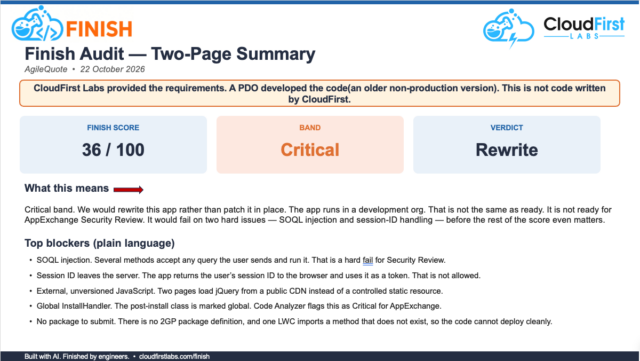

The first was an older, pre-production version of AgileQuote. We wrote the requirements; an outside product development outsourcer (PDO) built it. It is not the current product, and it was not AI-generated. We use it because it shows what no source of truth looks like, whoever writes the Apex.
The second was AgilePDF, a document-generation app written entirely in-house by CloudFirst Labs, in VS Code with Claude Code.
| Measure | AgileQuote (older PDO build) | AgilePDF (in-house, Claude Code) |
|---|---|---|
| Finish Score | 36 / 100, Critical | 89 / 100, Launch-Ready |
| CI/CD and source control | 1 / 5 | 2.5 / 5 |
| Commits | 41, one person under five name variants | 173, descriptive messages, tagged releases |
| Branches and review | main only | No reviewed pull-request flow yet |
| CI | None | Lint, Jest, and Code Analyzer on every push |
| Package | None; namespace empty | Second-generation managed package |
| Can the repo deploy as-is? | No: an LWC imports an Apex method that doesn’t exist | Yes |
That last AgileQuote row is the paste in one line. The org and the repo had drifted apart until the repo could no longer build the org.
AgilePDF lost points too. The org still held three classes that a commit had removed from source, so the org ran 511 tests to the repo’s 503. Even a well-run repo drifts. The difference is that you can see it.
Salesforce vibe coding: how to get your app into source control
You can do the first pass yourself in an afternoon. It won’t finish the app, but it will tell you how far from finished you are.
- Create an SFDX project.
sf project generate --name my-appgives you the folder structure every Salesforce tool expects. - Build a manifest from the org.
sf project generate manifest --from-org my-dev-org --output-dir manifestlists what’s actually deployed, not what you remember pasting. - Retrieve it.
sf project retrieve start --manifest manifest/package.xml --target-org my-dev-orgpulls the org into source. - Commit it.
git init, commit everything, and push to a private repo. This is now your source of truth. From here on, changes go into the repo first. - Scan it. Run
sf code-analyzer runwith Code Analyzer v5. It’s free. Add the AppExchange rule selector if a listing is the goal. - Prove the repo can rebuild the org. Create a scratch org and run
sf project deploy startagainst it. If it fails, you’ve found the drift.
Step 6 is the honest test. The older AgileQuote repo would have failed it on the missing Apex method. If yours fails, the error list is your first real backlog.
The toolchain is not the product
Salesforce has already made the generator cheap. Agentforce Vibes IDE, formerly Code Builder, ships with Salesforce’s VS Code extensions, the CLI, and Code Analyzer, and it can initialize a Git repo or publish to GitHub in a click. Agentforce Vibes also runs in VS Code-compatible editors like Cursor and Windsurf, and other agents can plug in through the Salesforce DX MCP Server.
Claude Code is in the same picture. Salesforce began deploying it across its global engineering organization in October 2025, and the Claudeforce partnership announced in August 2026 deepened that.
So the platform hands you Git. Salesforce vibe coding skips it anyway, because a chat window doesn’t ask.
That’s why “we use AI” isn’t a pitch. What’s scarce is a team that picks up the repo you already started and finishes the part the model doesn’t care about. Our toolchain is VS Code and Claude Code, into scratch orgs, into a pipeline, into the org you run. If you started in Cursor or Agentforce Vibes, we don’t make you switch. We pick up the repo.
Flow, Apex, and LWC, tangled on purpose
Salesforce vibe coding rarely produces one layer. They arrive as a Flow that should have been Apex, an LWC that re-implements the Flow, and a trigger on the same object as both.
Each piece works. Together they’re a race condition with a user interface.
You ended up with three ways to do one thing because the model offered three ways. An engineer picks one and writes down why. That decision is far easier in VS Code, against source, than in a chat window against production.
What we won’t do
- Pretend the model is the differentiator
- Relabel a React or Supabase rescue as Salesforce work
- Quote an hourly rate and hope the last 40% is small
- Call citizen developers sloppy for doing what the platform asked
We will take a 20–90% built Apex, LWC, and Flow app, score it, and then finish it or tell you to rebuild. More on that last 40% in The 60% Salesforce App.
When to get a score instead
The six steps above tell you whether the repo can rebuild the org. They don’t tell you whether the app is safe to ship. That’s what a Finish Audit answers.
In five to seven business days, for $4,500 fixed, you get a 0–100 Finish Score across six dimensions, a keep / refactor / rebuild verdict, a 45-minute architect walkthrough, and a fixed-price quote for whatever comes next. The fee is credited if you book a Finish Sprint or Finish for AppExchange within 30 days.
The full ladder and every price are on the Finish page.
If you already started, bring the repo, or the org if there is no repo yet. Book a 15-minute Finish Audit call, or email john@cloudfirstlabs.com with “Finish Score” in the subject.
The model got you here. The last mile isn’t another prompt.
FAQ
Is Salesforce vibe coding safe for production?
Yes, if it’s in source control, passes Code Analyzer, enforces CRUD and FLS, and has tests that assert real behavior. Pasting it straight from a chat into production skips all four.
How do I get Apex from ChatGPT or Claude into source control?
Create an SFDX project, generate a manifest from the org, retrieve, and commit to Git. Then prove the repo can deploy to a fresh scratch org. The six steps above walk through it.
Does Agentforce Vibes use Git?
Agentforce Vibes IDE can initialize a repo or publish to GitHub. It doesn’t make you use it. Plenty of Salesforce vibe coding projects never get a first commit.
Do I have to switch from Cursor or Agentforce Vibes to work with you?
No. We work from the repo. We ship in VS Code with Claude Code, but your starting tool doesn’t have to match ours.
What does a Salesforce code audit cost?
A Finish Audit is $4,500 fixed, five to seven business days, and credited toward a Sprint or AppExchange build booked within 30 days. See the Finish page.
Do you work on non-Salesforce apps?
Not through CloudFirst Finish. It’s Salesforce-only.
Built with AI. Finished by engineers.
About CloudFirst Finish
CloudFirst Finish takes a 20–90% built Salesforce app — Apex, LWC, Flow — and makes it documented, tested, and deployable. Finish Audit is $4,500 and five to seven days: a 0–100 Finish Score and a keep/refactor/rebuild verdict. Sprint, AppExchange packaging, and Watch sit behind that score. Prices and the ladder live on cloudfirstlabs.com/finish.
About CloudFirst Labs
CloudFirst Labs is a Tampa Salesforce consulting and AppExchange partner. The same bench that finishes AI-started apps is the bench that connects the Salesforce CRM, PSA, and billing systems MSPs run every day — ConnectWise, Autotask, ServiceNow, NetSuite, Certinia — so closed deals flow into delivery and invoices match what was sold. Co-founded by a former VP of Technology at a $200M MSP.
Connect with John Dionne on LinkedIn and follow CloudFirst Labs for Finish and MSP systems writing, or browse more on the CloudFirst Labs blog.