
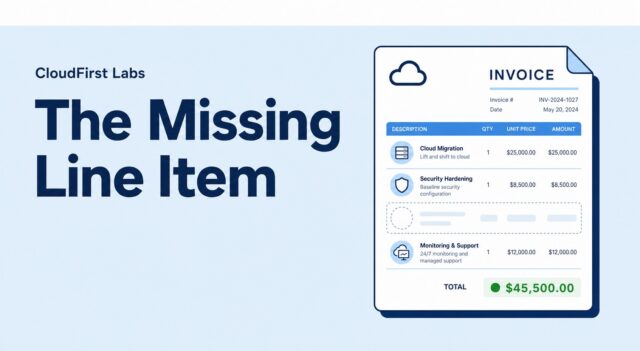
Most MSP margin problems don’t announce themselves. Nobody sends a quote out the door thinking they just gave away three points of margin. But across a quarter of deals, that’s exactly what happens — one missing line at a time.
What MSP Quote Margin Leakage on a Quote Actually Looks Like
Ask any MSP operations leader to describe their worst quoting headaches and you rarely hear “our pricing is wrong.” You hear something closer to this: a warranty that didn’t get added. A required service line that quietly fell off. An implementation fee everyone assumed was baked in somewhere. A dependent product that never made it onto the quote at all.
None of these look like quoting failures in the moment. They look like small oversights. The customer signs. The deal closes. Everyone moves on. It’s only weeks later, when service delivery starts the engagement and finance tries to reconcile what was sold against what’s being delivered, that the gap becomes visible — and by then it’s absorbed as a cost of doing business instead of flagged as a process failure.
Why This Keeps Happening to Good Sales Teams
This isn’t a talent problem. Experienced reps miss line items just as often as new ones, because the quote-building process usually depends on memory, habit, or whatever template happened to be open. When there’s no system enforcing which lines are required for a given product or service package, the quote is only as complete as the person building it remembers to make it.
For MSPs specifically, this gets harder because the product catalog isn’t static. Warranty terms change. Vendor requirements shift. A managed service package that required three line items last quarter might require four this quarter after a vendor price change. Without a system that enforces those dependencies, that knowledge lives in someone’s head — and heads change jobs, get busy, or simply forget.
The Real Cost Across a Quarter, Not Just One Deal
One missing line item on one quote might cost a few hundred dollars of margin. That’s easy to shrug off. The problem is scale. Across dozens of quotes a month, small consistent misses compound into a material hit to gross margin — and because each instance looks minor in isolation, it rarely gets flagged as a pattern worth fixing. It just shows up later as “why is our margin softer than it should be this quarter,” with no obvious single cause.
Why the CPQ Conversation Has Gotten More Complicated
For Salesforce-based MSPs, this conversation has an added wrinkle right now. Salesforce CPQ is being phased out in favor of Revenue Cloud, and Revenue Cloud is a genuinely powerful platform — but it’s also built for a scale and complexity that most MSPs quoting managed services, hardware, and project work don’t actually need. Committing to a full enterprise CPQ migration just to make sure a warranty line doesn’t get dropped is a lot of overhead for a fairly specific problem.
A Simpler Fix: Control Without Enterprise Overhead
What most MSPs actually need isn’t a bigger CPQ platform. It’s control: bundles that pull in the right components automatically, required lines that can’t be removed without an override, dependent items that follow the parent product, excluded options that prevent incompatible combinations, and quantity minimums and maximums that catch fat-finger errors before they reach the customer.
This is the specific gap AgileQuote is built to close for Salesforce-native MSPs — enough structure to stop the quoting problems that quietly erode margin, without the implementation weight of a full enterprise CPQ rollout.
A Quick Audit You Can Run This Week
You don’t need new software to start finding this problem. Pull your last 15-20 closed-won quotes and compare them against what was actually delivered or invoiced. Look specifically for: warranty or support lines that were assumed but not itemized, implementation or onboarding fees that got bundled informally instead of quoted, and dependent products that should have appeared together but didn’t.
If you find even two or three instances in that sample, you have a process gap worth fixing — not a training problem, a systems one. Fast quoting is useful. Controlled quoting is what protects the business.
About CloudFirst Labs
CloudFirst Labs connects the Salesforce CRM, PSA, and billing systems MSPs run every day — so closed deals flow automatically into delivery, invoices match what was sold, and leadership can finally trust the forecast. Co-founded by a former VP of Technology at a $200M MSP, we’ve lived the integration problems we solve. Book a free MSP Revenue Assessment to see where your systems are leaking margin.
Connect with John Dionne on LinkedIn for more MSP systems and revenue-operations insights, or browse more MSP Insights on the CloudFirst Labs blog.