Quoting inconsistency almost never shows up when an MSP is small — until scaling exposes exactly the gap that CPQ for MSPs on Salesforce is built to close. It shows up the moment the team starts growing — which is exactly the moment it becomes expensive to ignore.

Inconsistency Doesn’t Show Up Until You’re Growing

At two or three reps, differences in quoting are invisible because everyone is close enough to every deal to catch problems informally. Add headcount, and that informal safety net disappears. One rep structures a quote a certain way because that’s how they learned it. Another pulls up an old quote from a similar customer and edits it in place. A third builds a new one from memory because they’ve closed that type of deal a dozen times before.

The customer on any single deal probably never notices. What they get still looks like a professional, complete quote. But internally, the business is now running three different versions of “how we quote,” each with its own assumptions about pricing logic, service lines, and structure.

What Inconsistent Quoting Actually Costs You

This isn’t just an aesthetic problem. Different quote structures create different handoff quality and service delivery, different assumptions about what’s included, and different pricing logic, making it hard to spot when a deal is underpriced relative to your standard. It also makes onboarding new sales reps harder, because there’s no single source of truth for “this is how we quote a managed services renewal” versus “this is how we quote a new project.”

The deeper cost is that this kind of inconsistency is very hard to see from the top. Nobody schedules a meeting to discuss it, because no single quote looks broken. It’s the aggregate pattern — reviewed only when someone finally audits a batch of quotes side by side — that reveals how much variation has crept in.

Repeatability Without Losing Flexibility

The instinct when this gets noticed is often to add process: more approval steps, more manual review, more oversight. That slows everyone down without actually fixing the root cause, which is that reps have no consistent starting point.

What MSPs actually need is repeatability that still leaves room for judgment — the core job of a CPQ built for MSPs running Salesforce. Common projects, standard service packages, renewals, and expansions shouldn’t require rebuilding the same logic every time a rep opens a new quote. The goal isn’t to remove flexibility — it’s to stop reps from reinventing the wheel on deals that are structurally similar to ones they’ve already closed successfully.

Quote Cloning, Group Cloning, and CPQ for MSPs on Salesforce: What They Solve

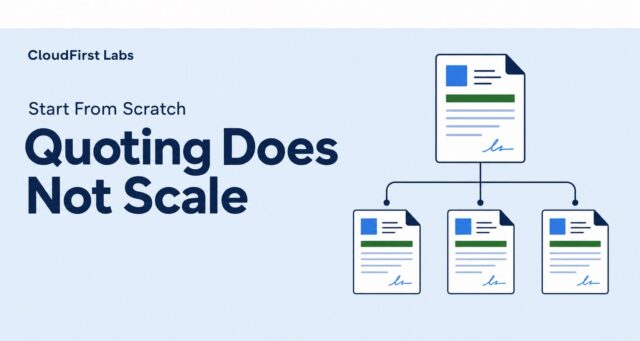
This is where quote cloning and group cloning earn their keep. Instead of starting from a blank page, a rep starts from a proven structure — the same service lines, the same pricing logic, the same layout that’s already been validated — and adjusts it for the specific customer in front of them. It’s a cleaner starting point, not a rigid script.

For Salesforce-native MSPs, this is the specific capability AgileQuote — our Salesforce-native CPQ for MSPs — is designed around: repeatable quote structures that scale with the sales team.
CPQ for MSPs on Salesforce

Building This Into Your Growth Plan

If you’re planning to add sales headcount, ensure quote consistency before the new hires start, not after. Growth doesn’t create quoting inconsistency out of nowhere — it exposes inconsistency that was already latent in the process, just at a scale small enough to go unnoticed.

A simple test: pull five recent quotes for the same type of engagement from five different reps. If they don’t look structurally similar — same sections, same required lines, same layout logic — you already have the problem. Build repeatability now, while it’s a process fix, rather than later, when it’s a training and cleanup project across a much bigger team.


About CloudFirst Labs

CloudFirst Labs connects the Salesforce CRM, PSA, and billing systems MSPs run every day — so closed deals flow automatically into delivery, invoices match what was sold, and leadership can finally trust the forecast. Co-founded by a former VP of Technology at a $200M MSP, we’ve lived the integration problems we solve. Book a free MSP Revenue Assessment to see where your systems are leaking margin.

Connect with John Dionne on LinkedIn for more MSP systems and revenue-operations insights, or browse more MSP Insights on the CloudFirst Labs blog.
Most MSP margin problems don’t announce themselves. Nobody sends a quote out the door thinking they just gave away three points of margin. But across a quarter of deals, that’s exactly what happens — one missing line at a time.

What MSP Quote Margin Leakage on a Quote Actually Looks Like

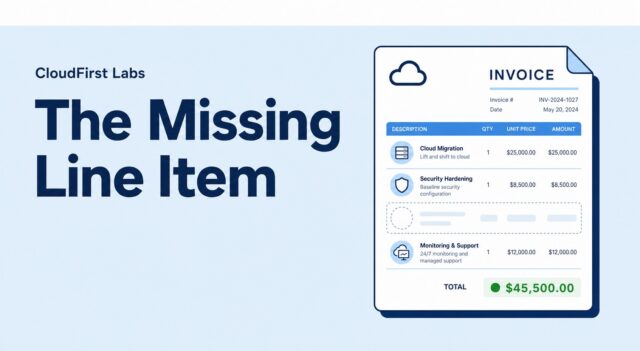
Ask any MSP operations leader to describe their worst quoting headaches and you rarely hear “our pricing is wrong.” You hear something closer to this: a warranty that didn’t get added. A required service line that quietly fell off. An implementation fee everyone assumed was baked in somewhere. A dependent product that never made it onto the quote at all.

None of these look like quoting failures in the moment. They look like small oversights. The customer signs. The deal closes. Everyone moves on. It’s only weeks later, when service delivery starts the engagement and finance tries to reconcile what was sold against what’s being delivered, that the gap becomes visible — and by then it’s absorbed as a cost of doing business instead of flagged as a process failure.

MSP Quote Margin Leakage: The Missing Line Item Problem | CloudFirst Labs

Why This Keeps Happening to Good Sales Teams

This isn’t a talent problem. Experienced reps miss line items just as often as new ones, because the quote-building process usually depends on memory, habit, or whatever template happened to be open. When there’s no system enforcing which lines are required for a given product or service package, the quote is only as complete as the person building it remembers to make it.

For MSPs specifically, this gets harder because the product catalog isn’t static. Warranty terms change. Vendor requirements shift. A managed service package that required three line items last quarter might require four this quarter after a vendor price change. Without a system that enforces those dependencies, that knowledge lives in someone’s head — and heads change jobs, get busy, or simply forget.

The Real Cost Across a Quarter, Not Just One Deal

One missing line item on one quote might cost a few hundred dollars of margin. That’s easy to shrug off. The problem is scale. Across dozens of quotes a month, small consistent misses compound into a material hit to gross margin — and because each instance looks minor in isolation, it rarely gets flagged as a pattern worth fixing. It just shows up later as “why is our margin softer than it should be this quarter,” with no obvious single cause.

Why the CPQ Conversation Has Gotten More Complicated

For Salesforce-based MSPs, this conversation has an added wrinkle right now. Salesforce CPQ is being phased out in favor of Revenue Cloud, and Revenue Cloud is a genuinely powerful platform — but it’s also built for a scale and complexity that most MSPs quoting managed services, hardware, and project work don’t actually need. Committing to a full enterprise CPQ migration just to make sure a warranty line doesn’t get dropped is a lot of overhead for a fairly specific problem.

A Simpler Fix: Control Without Enterprise Overhead

What most MSPs actually need isn’t a bigger CPQ platform. It’s control: bundles that pull in the right components automatically, required lines that can’t be removed without an override, dependent items that follow the parent product, excluded options that prevent incompatible combinations, and quantity minimums and maximums that catch fat-finger errors before they reach the customer.

This is the specific gap AgileQuote is built to close for Salesforce-native MSPs — enough structure to stop the quoting problems that quietly erode margin, without the implementation weight of a full enterprise CPQ rollout.

A Quick Audit You Can Run This Week

You don’t need new software to start finding this problem. Pull your last 15-20 closed-won quotes and compare them against what was actually delivered or invoiced. Look specifically for: warranty or support lines that were assumed but not itemized, implementation or onboarding fees that got bundled informally instead of quoted, and dependent products that should have appeared together but didn’t.

If you find even two or three instances in that sample, you have a process gap worth fixing — not a training problem, a systems one. Fast quoting is useful. Controlled quoting is what protects the business.

About CloudFirst Labs

CloudFirst Labs connects the Salesforce CRM, PSA, and billing systems MSPs run every day — so closed deals flow automatically into delivery, invoices match what was sold, and leadership can finally trust the forecast. Co-founded by a former VP of Technology at a $200M MSP, we’ve lived the integration problems we solve. Book a free MSP Revenue Assessment to see where your systems are leaking margin.

Connect with John Dionne on LinkedIn for more MSP systems and revenue-operations insights, or browse more MSP Insights on the CloudFirst Labs blog.
The Best Solution

In my first CPQ-focused blog post “Real World CPQ in Salesforce”, I discussed what CPQ is and what some of your options are.  In this post, I talk about the many reasons companies choose AgileQuote, including its ease of use, rich feature set, quick deployment, and low cost.  Our application can be implemented in hours and saves countless clicks when creating quotes and opportunities.  But don’t just take our word for it, let’s review some actual examples!

Speed

Three Wire Systems, a technology solutions provider for government and military, was looking for a tool that improved their speed and accuracy for processing orders.  The current crop of applications didn’t meet their criteria, so they turned to AgileQuote.  Simone Feldman, former Sr VP of the Technology Business Unit put it very succinctly: “The flexibility offered by AgileQuote has made all the difference for Three Wire Systems, allowing us to customize on the fly and streamlining our ability to go from RFQ to quote in less than 25% of the time it [used to take].  This has improved our reporting capabilities for tracking sales and quotes and made forecasting straight from the system possible.”

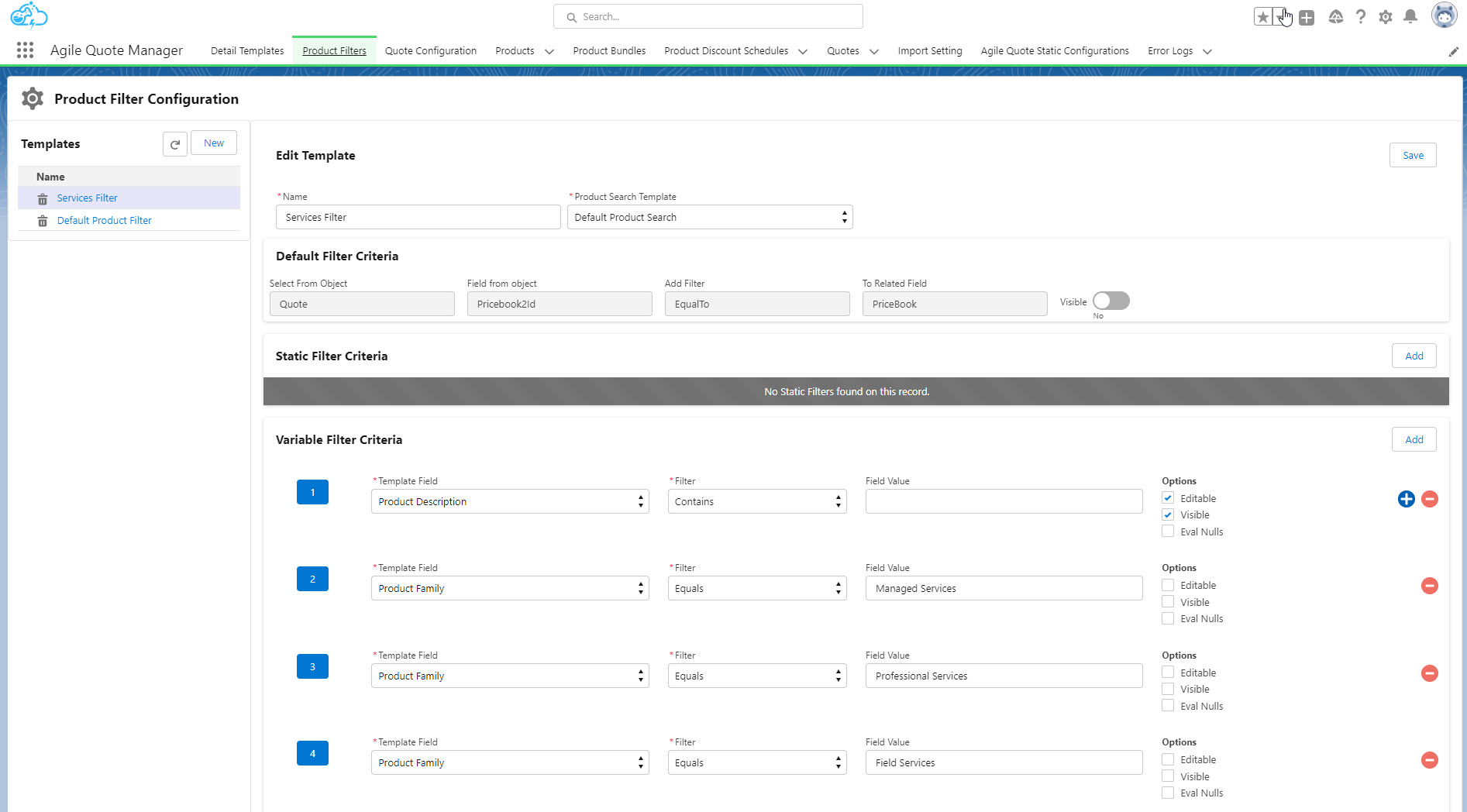
Not only is creating Opportunities and Quotes fast, but implementation time is also lightning quick and easy.  The goal of the tool was for customers to be able to self-implement in a few hours or a day, not in weeks or months.  All configuration is accomplished via setup screens, including quote line templates and powerful product search filtering:

Product Filter Config Screen

Configurability

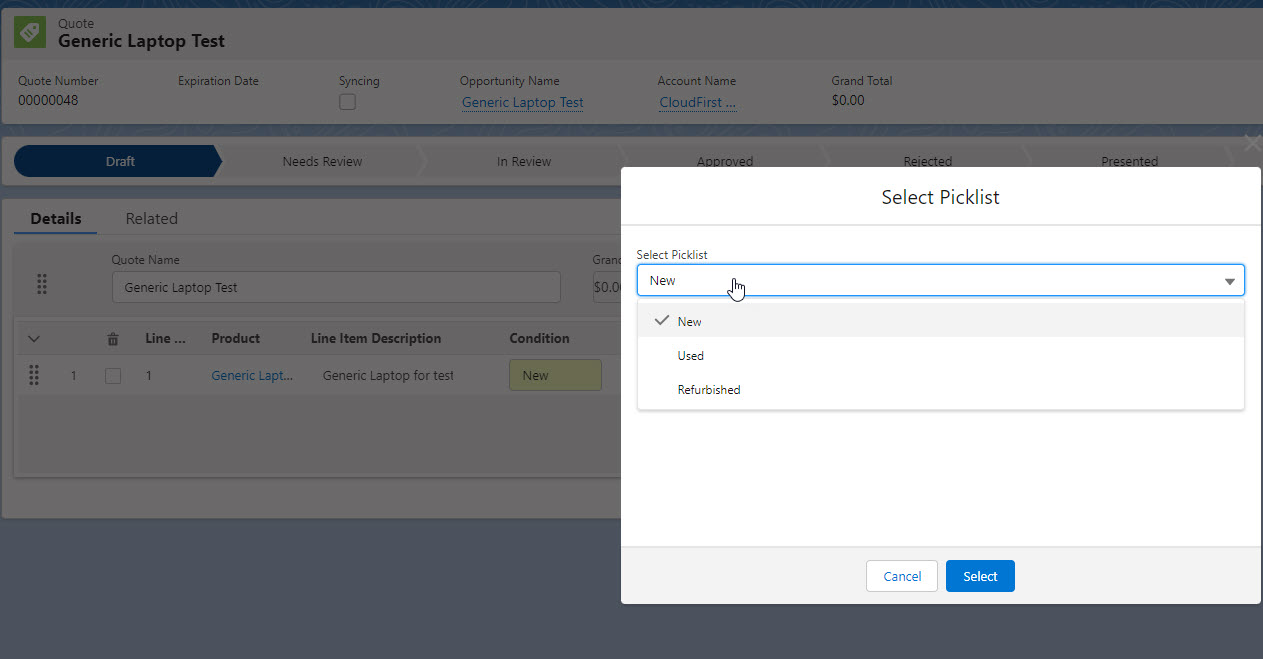
Another technology solutions provider, Moving On IT Solutions, required a quoting tool that was intuitive and flexible.  Compared to our other customers, they had a unique use case that AgileQuote and Salesforce easily managed: the ability to sell the same hardware SKU in different conditions such as New, Used, or Refurbished:

Select product condition

As Jan Collis, the CEO of Moving On IT states, “AgileQuote allows our team to easily create quotes for our customers based on their needs.  We are relatively new to the Salesforce platform, and AgileQuote has made adoption a breeze.  We’re able to have a quote to our customers within minutes of getting off the phone with them!” 

Functionality

AgileQuote provides functionality that you usually find in larger, more expensive applications such as product bundles, pricing discounts, dropship/fulfillment, and custom error handling.  Because AgileQuote uses the standard Salesforce quote objects, we can provide custom processing and implement business rules easily via Flows.

It was important for CloudFirst Labs to provide structured visibility and to allow processing via standard Salesforce declarative methods, using clicks not code.

Try It, You’ll Like It

Customers can always visit our AppExchange listing and start a trial in a Sandbox, which is what we recommend.  We provide configuration documentation, Quick Start guides, and YouTube videos to get you up and running, and the team is always available to answer questions or review your use cases before or during your evaluation!

CloudFirst Labs logo

Exploring Real world CPQ in Salesforce

It’s no secret or uncontested fact when I say that Salesforce CPQ (Configure, Price, Quote) is the most comprehensive and complete solution for the Salesforce platform.  Hands down, end of story.

However, that solution is not for every customer and every situation, and in some cases, there are more nimble and affordable solutions available.

What is CPQ? 

CPQ stands for Configure, Price, Quote.  Fairly self-explanatory if we lay the ground rules that any tool which lets you:

  • Configure products for a quote (bundles or with add-ons) based on rules or constraints
  • Price products or bundles based on rules or discounts (user or customer based)
  • Send a quote (or proposal) to the customer

Fits into our definition of CPQ.  While almost every version of Salesforce incorporates the Opportunity object, there are scenarios where a customer wants to drop a level below an Opportunity and provide a Quote to their customers.  Why?  There are several reasons: 

  • A salesperson wants to present different quotes to address;
    • various brands or manufacturers (competitive or alternate products)
    • levels of services or support (different SLA or coverages)
  • The company may offer discounts on their products based on payment terms

Some might ask, why not make another Opportunity?  The answer is that we don’t want to artificially inflate the company forecasting pipeline, because while a deal (Opportunity) may have several differently priced options (Quotes), only the Quote the customer is favoring should be included in your pipeline.

CPQ Basics 

The fundamentals of CPQ are easy to understand.  You use objects (Quote and Quote Line) in order to select products to sell to your customer.  These objects should link back to an Opportunity using standard Salesforce syncing.

In CPQ land, these selected products may require the configuring of attributes or features based on defined rules and what product options may require or exclude others(for example if you have complex rules (constraints) surrounding bundles of products, which itself can be infinitely complex and daunting).

After you have the correct products selected, you price thems.  Do you get volume discounts, new customer incentives, or return customer bonuses?  Again, pricing rules can be dependent on the conditions of the product (new, certified refurbished, etc.), purchase volume, customer status, supply chain considerations, and even seasonality in some cases.  As a company you may want to place limits on what the pricing options are and follow strict guidelines, providing the rules instead of letting salespeople price on their own.

Lastly, when the products and pricing are approved you can send the customer an electronic Quote document based on those products and pricing.  This document can be as simple as listing product info, prices, tax, shipping, surcharges, and a total.  Or it can include payment terms, conditions, company info, sales/specials, and can be more of a long proposal format.  But the option is there by using a document generation tool like Conga, or you can always build documents on your own using Lightning components or Visualforce.

Overkill and Options

What if we have simple requirements, a limited budget, and are in a time crunch?

In Salesforce, advanced versions do provide quoting objects and screens, so you can quote within the standard interface you have come to know and love.  You have the ability, albeit limited, to do CPQ at a basic level if that’s all you need. 

Alternatively, if you have requirements that surpass the capabilities of basic quoting, but don’t require the complexities of Salesforce CPQ, you should look at more purpose-built, nimble, and less expensive options. 

Our customers choose AgileQuote because it exceeds their current CPQ requirements in an easy-to-use and affordable way. The many features we include are dedicated to reducing the number of clicks to quote and saves users quite a bit of time (and money). 

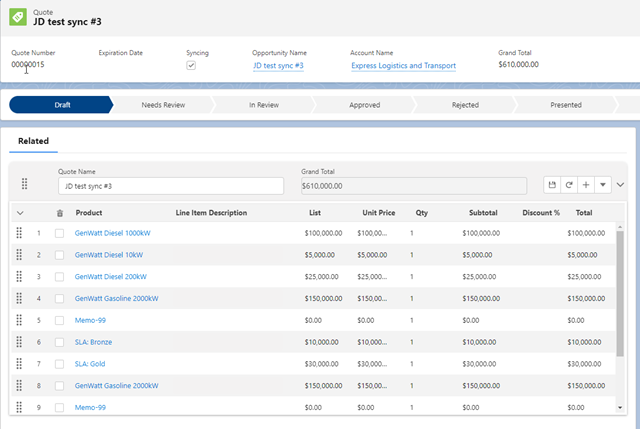
AgileQuote Line Editor

Whether you need powerful in-line quote creation, editing/re-ordering on a single screen, or configurable layouts and discounts, AgileQuote was built for speed, both on the configuration and use of the tool.

Choose What Works

At CloudFirst Labs, we always recommend the best solution for prospects evaluating CPQ.  We have recommended all three options we discussed: standard Salesforce, AgileQuote, and Salesforce CPQ to customers, based on their needs.
 
Need help in addressing your CPQ requirements? We’d be happy to provide insights and guide you to the best solution. Click here to reach out and talk to an expert. 

CloudFirst Labs Logo