
Most MSP owners already know billing is messy. What fewer realize is exactly how much money that messiness is costing them every year — because MSP revenue leakage doesn’t show up as a single bad number.
What Revenue Leakage Actually Looks Like Inside an MSP
Revenue leakage rarely looks like fraud or a single obvious error. It looks like a technician who does 20 minutes of extra work that never gets logged against a billable code. It looks like a project that wraps up two weeks before the final invoice actually goes out. It looks like a price increase that was approved verbally but never made it into the PSA, so the client keeps getting billed at last year’s rate. Each instance is small. None of them individually would trigger an audit.
The pattern connects back to one root cause: your PSA, your CRM, and your billing system each hold a different version of the truth about what was sold, what was delivered, and what should be invoiced. When those three don’t agree, revenue falls into the gaps between them.
The Math: How a Few Percentage Points Becomes Real Money
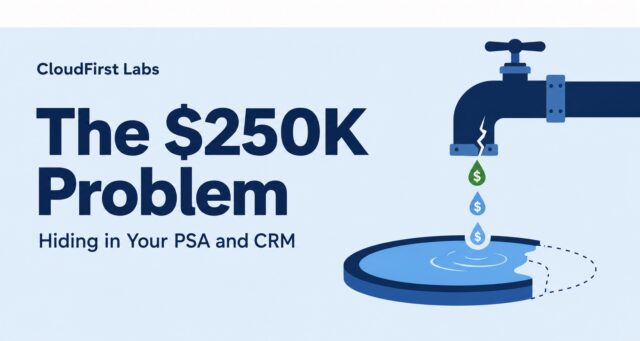
Industry data on MSP revenue leakage puts the scale of this in perspective. Rev.io’s analysis of MSP billing practices finds that MSPs typically lose 5% to 15% of annual revenue to billing inefficiencies. Run that percentage against a $5M MSP and the range lands at $250,000 to $750,000 a year — money for work that was already done, just never fully captured.
That’s the part that’s easy to miss. The technical work happens. The client relationship stays intact. The money simply doesn’t follow the work all the way to the bank account.
Why This Is a Systems Problem, Not a Billing Problem
The instinct when revenue leakage gets flagged is to blame the billing process specifically — maybe assign someone to double-check invoices before they go out, or add a monthly reconciliation step. That helps at the margins, but it treats the symptom, not the cause.
The actual cause is fragmentation. If your CRM records a deal one way, your PSA tracks delivery a different way, and your billing system generates invoices from yet another source of truth, no amount of manual double-checking will fully close every gap — it will just catch some of them, some of the time, at the cost of someone’s full-time attention.
Where to Look First: PSA, CRM, and Billing Alignment
Start by tracing a single client relationship end to end: what was sold in the CRM, what was actually delivered and logged in the PSA, and what appeared on the resulting invoice. If those three don’t match cleanly — if there’s a service the client is receiving that isn’t reflected in what they’re being billed for, or a contract term that never made it into the billing system — you’ve found a live leak, not a hypothetical one.
Do this for three or four accounts, prioritizing your longest-tenured clients, since misalignment tends to compound the longer a relationship runs without a system check.
What “Fixed” Actually Looks Like
Fixing revenue leakage doesn’t mean adding more oversight. It means making sure your CRM, PSA, and billing platform share one connected source of truth, so what’s sold, what’s delivered, and what’s billed are the same data set viewed from three angles — not three separate records that happen to usually agree.
The MSPs that solve this aren’t just protecting margin. They’re building a business with cleaner customer insight, tighter operations, and a far easier story to tell the next time someone — a lender, an investor, or a buyer — asks how confident they should be in the numbers.
About CloudFirst Labs
CloudFirst Labs connects the Salesforce CRM, PSA, and billing systems MSPs run every day — so closed deals flow automatically into delivery, invoices match what was sold, and leadership can finally trust the forecast. Co-founded by a former VP of Technology at a $200M MSP, we’ve lived the integration problems we solve. Book a free MSP Revenue Assessment to see where your systems are leaking margin.
Connect with John Dionne on LinkedIn for more MSP systems and revenue-operations insights, or browse more MSP Insights on the CloudFirst Labs blog.